A Guide to Greek Traditions and
Customs in America
Second Edition, by
Marilyn Rouvelas.
411 pages. Hardbound, notes, illustrations, and
bibliography.
DCGreeks.com
Online Price: $30

WEDDING
(page 57)
Preserving the Marriage Crowns--Stephanothiki
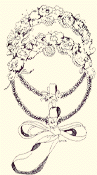 ....The stephana are one of the most important symbols of the marriage.
They remind the newlyweds that they are now united in their own kingdom with the
blessing of God, and they have a chance to build their own home and family
together. The crowns deserve to be properly preserved. Place the crowns in the
home ikonostasi or in a special case called a stephanothiki....
....The stephana are one of the most important symbols of the marriage.
They remind the newlyweds that they are now united in their own kingdom with the
blessing of God, and they have a chance to build their own home and family
together. The crowns deserve to be properly preserved. Place the crowns in the
home ikonostasi or in a special case called a stephanothiki....
POPULAR MUSIC
(page 191)
....After World War II, music featuring the bouzouki became the rage all
over Greece. Respectable composers like Mikis Theodorakis and Manos Hatzidakis
began using the tantalizing sound. Popularly referred to as bouzouki
music, nightclubs called bouzoukia flourished and continue to do so
today. . .The bouzouki is now considered the premier Greek instrument.
With electrification, the power and force of the bouzouki evokes an
extreme range of emotions. During a solo taxim, the bouzouki takes
the listener from painful loneliness to exuberant happiness. Like the violin, it
possesses a haunting quality even in upbeat compositions....
EASTER
(page 286)
....A delicious supper of traditional foods follows the [midnight Easter]
service even though the hour is late. Instead of a prayer before the meal, "Christos
Anesti" is sung three times in honor of the Trinity, and everyone
chooses a red egg to crack with someone else. Eggs are cracked large end to
large end and small end to small end with the competitors saying, "Christos
anesti" and "Alithos anesti," symbolizing Christ's
emergence from the tomb. Through the process of elimination a
"champion" unbroken egg is left. The holder is declared the winner and
expected to have good luck all year....
BAPTISM
(page 40)
....The child is dressed in new white clothing during the ceremony to signify
purification and new life from the rebirth of baptism. The outfit includes
diaper, underwear, dress or suit, socks, shoes, two hats (one should be an
absorbent liner) and possibly a coat, depending on the season. The clothing
should cover the child as much as possible to absorb the holy oil from the
ceremony....
FORTY-DAY MEMORIAL SERVICE AFTER DEATH
(pages 144-5)
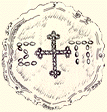 ....It is traditional for the family to sit in the front row of the church
before the icon of Christ during the service. The family provides a wheat dish
called kollyva, a symbolic custom based on [Biblical scripture]:
....It is traditional for the family to sit in the front row of the church
before the icon of Christ during the service. The family provides a wheat dish
called kollyva, a symbolic custom based on [Biblical scripture]:
Truly, truly, I say to you, unless a grain of wheat falls into
the earth and dies, it remains alone; but if it dies, it bears much fruit.
John: 12:24
The Christian message of everlasting life and hope is
symbolically represented by the white mound of kollyva on a tray bearing
a cross and the deceased's initials in Greek. The tray rests on a small table
with candles in front of the church ikonostasion during the memorial
service. After church the family shares the kollyva with the rest of the
congregation.... [Recipe provided on page 149]
THE HISTORIC ORTHODOX CHURCH
(page 307)
. . . In 324, Emperor Constantine declared his intention to
expand the Roman Empire to the East, moved the capital from Italy to the small
Greek town of Byzantium in Asia Minor on the Bosphorus River, and renamed it
after himself, Constantinople (modern-day Istanbul). Meanwhile, Christians
struggled to define their faith, especially the nature of Christ and the
structure of the church. In a bold move, Emperor Constantine called for and
presided over the first of seven Ecumenical Councils that defined the Christian
faith.
THE GREEK DIASPORA
(page 356)
. . .According to Richard Clogg in The Greek Diaspora in the
Twentieth Century, the countries with the largest Greek Diaspora population, in
descending order, are the United States, Australia, the republics of the former
Soviet Union, Canada, South Africa, Germany, Argentina, and Brazil.
DCGreeks.com
Online Price: $30